Verb (Group 1) (Basic ㊦ 149)
Someone or something moves in a direction away from the speaker or the speaker’s viewpoint.
Equivalent: Go; come
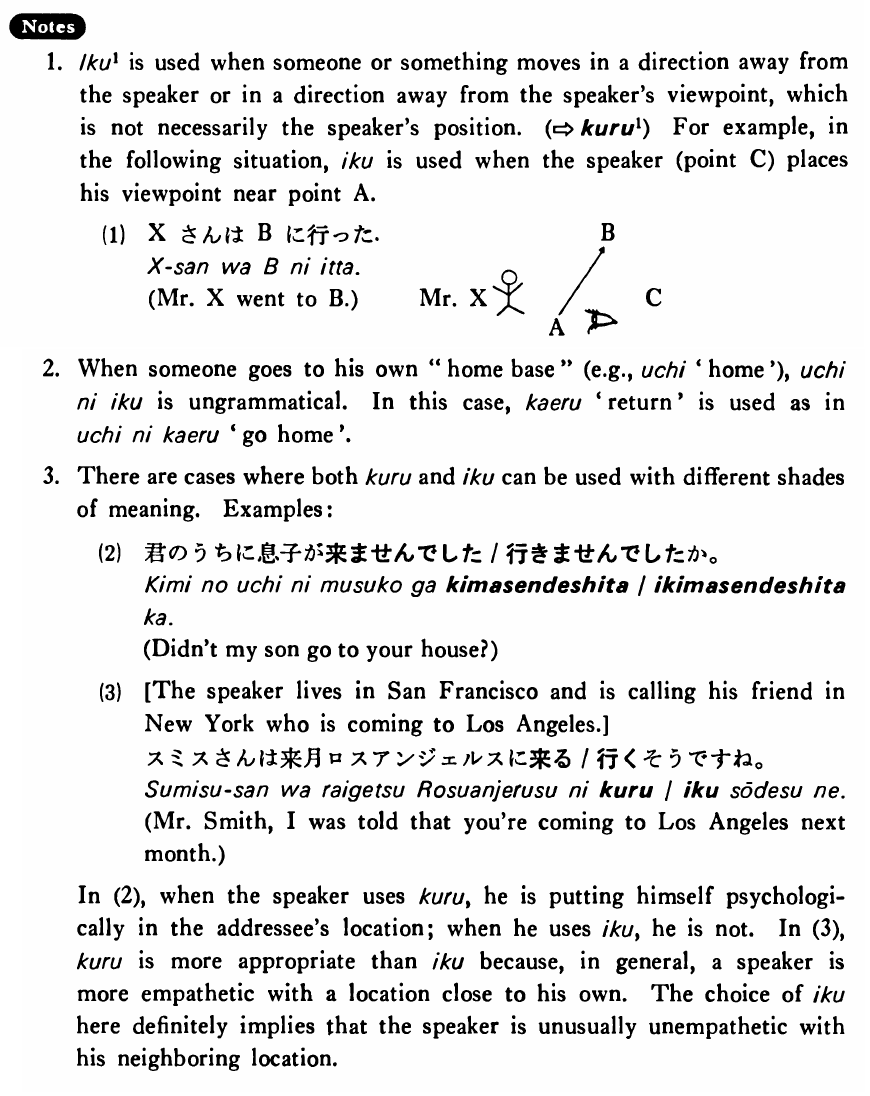
1. 行く1 is used when someone or something moves in a direction away from the speaker or in a direction away from the speakers viewpoint, which is not necessarily the speaker's position. (⇨ 来る1) For example, in the following situation, 行く is used when the speaker (point C) places his viewpoint near point A.
| B | ||
| Xさん (^_^) | / | C |
| A [うち] |
2. When someone goes to his own "home base" (e.g., うち 'home'), うちに行く is ungrammatical. In this case, 帰る 'return' is used as in うちに帰る 'go home'.
3. There are cases where both 来る and 行く can be used with different shades of meaning. Examples:
In (2), when the speaker uses 来る, he is putting himself psychologically in the addressee's location; when he uses 行く he is not. In (3), 来る is more appropriate than 行く because, in general, a speaker is more empathetic with a location close to his own. The choice of 行く here definitely implies that the speaker is unusually unempathetic with his neighboring location.